Cetinje and Lovćen
Former royal capital at 670 metres and karstic massif peaking at 1749 metres, a historic and panoramic stage between the Bay of Kotor and Lake Skadar.
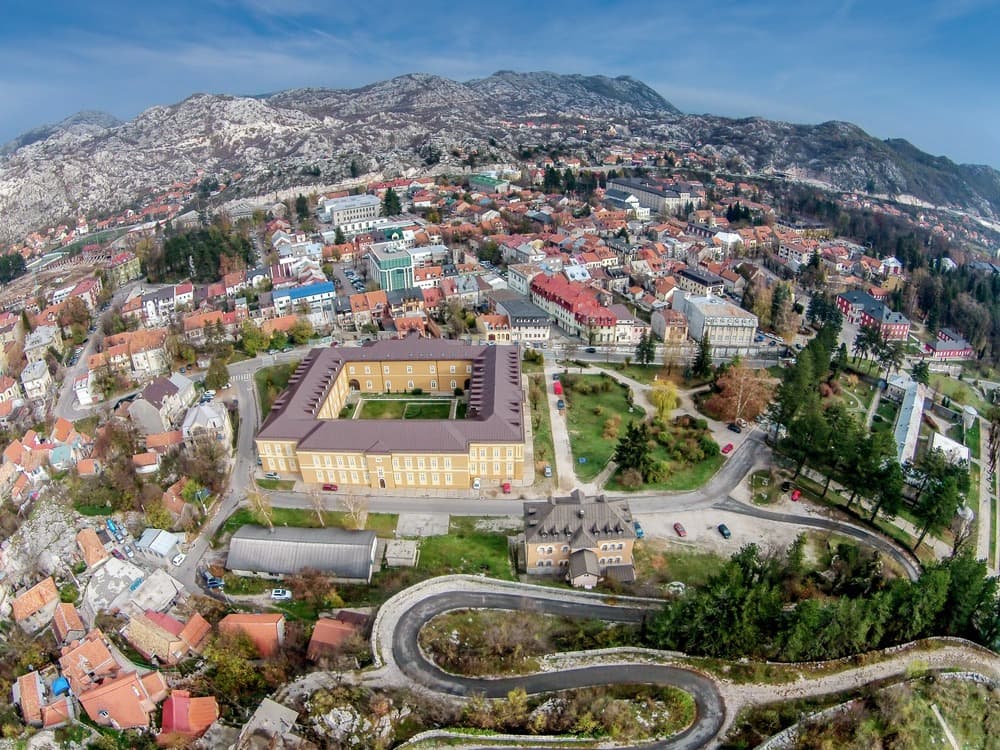
Cetinje sits in a karstic basin at 670 metres elevation, nestled between the slopes of Lovćen and the massifs descending towards Lake Skadar. It was here, in this plain enclosed by white limestone and sage, that the prince-bishops Petrović-Njegoš established Monténégro's capital in the late 15th century, after abandoning Žabljak Crnojevića on the lake's shores. The town preserves a compact layout around a few cobbled streets, a monastery and the Royal Palace of Nikola I, the country's last king before 1918.
The contrast with the coast is immediate. A one hour fifteen minute drive from Kotor along the winding Njeguški pass road, you transition from Mediterranean warmth to continental alpine climate, drier in summer, sometimes snow-covered from December to March. The village of Njeguški, halfway up the pass, is known for its pršut, ham dried in the bora wind descending from Lovćen, and for its sheep's cheese aged in brine. Most of our clients stop here for an hour, long enough for lunch in a family konoba.
Cetinje itself can be explored on foot in half a day. The Orthodox monastery, rebuilt in 1701 after Ottoman destruction, preserves the mummified right hand of St John the Baptist and a fragment of the True Cross, relics that arrived via the Russian imperial family in the early 20th century. Around it, several former diplomatic legations (French, English, Italian, Serbian) built between 1890 and 1914 testify to the period when Cetinje was a true European capital, courted by the great powers. The National Museum, housed in the Government Palace, displays the Virgin of Filermo, a Byzantine icon attributed to St Luke and which passed through Rhodes, Malta and St Petersburg before arriving here in 1952.
Lovćen National Park begins fifteen kilometres to the southwest. It is a karstic massif of 62 km², dominated by two peaks: Štirovnik (1749 m) and Jezerski Vrh (1657 m), the latter crowned by the mausoleum of Petar II Petrović-Njegoš, poet, philosopher and prince-bishop who died in 1851. The current structure, designed by Croatian sculptor Ivan Meštrović, was inaugurated in 1974 after a long political controversy. It is reached by a tunnel carved into the rock and then 461 stone steps. From the terrace, in clear weather from June to September, the panorama encompasses the Bay of Kotor seventeen hundred metres below, Lake Skadar to the east and the Prokletije chain, the Albanian Alps, to the southeast.
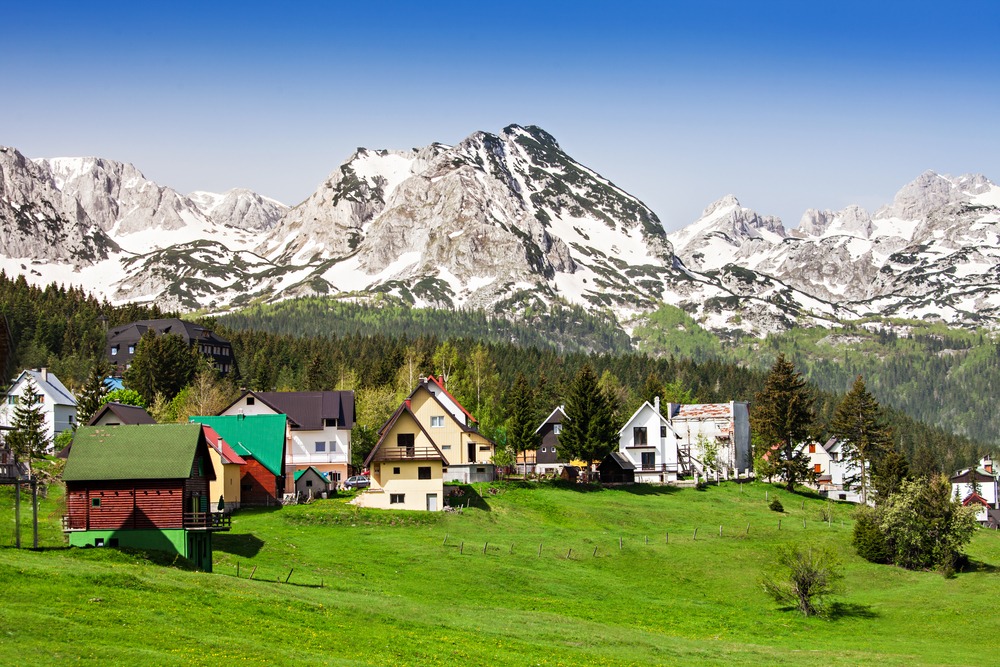
The region remains sparsely populated. Cetinje has 14,000 inhabitants, villages in the park (Ivanova Korita, Krstac) only dozens each. The economy relies on administration, passing tourism and extensive sheep herding on alpine pastures. Beech and black pine forests cover the northern slopes of Lovćen, while the southern slopes, exposed and dry, are mostly covered in juniper and stony meadows. This is interesting hiking terrain, without major technical difficulty, with marked trails from Ivanova Korita towards the peaks.
For a traveller, Cetinje and Lovćen form a transitional stage between coast and interior, both the historical centre of the country and gateway to Lake Skadar. It is also the only place where you can grasp in a few hours the political and religious fabric that built the Montenegrin state, from Orthodox monasticism to court diplomacy.
Must-see
Njegoš Mausoleum at the summit of Lovćen. 461 steps carved into limestone lead to the tomb at 1657 metres, with clear views over the Bay of Kotor, Lake Skadar and the Albanian Alps in fine weather.
Cetinje Monastery and its relics. The church preserves the mummified right hand of St John the Baptist and a fragment of the True Cross, within a monastic complex rebuilt in 1701.
Lunch of pršut in Njeguški. On the pass between Kotor and Cetinje, the village produces ham dried in the bora wind and sheep's cheese aged in brine, served in a few family konobas.
Historic diplomatic legations. The buildings of the French, Russian, English and Italian embassies, constructed between 1890 and 1914, recall that Cetinje was a capital courted by European powers before 1918.
Hiking from Ivanova Korita. Marked trails through beech forests and karstic pastures of the national park, without technical difficulty, towards the peaks of Jezerski Vrh and Štirovnik.
When to go
The best window for Cetinje and Lovćen runs from mid-May to mid-October. In summer, the Cetinje basin remains cooler than the coast, around 24 to 28°C daytime in July-August, versus 32 to 35°C in Kotor. On the Lovćen mausoleum, expect 8 to 10°C cooler than sea level, so bring a fleece even in peak summer. Visibility from the summit is clearest in June and September, when summer humidity has dissipated. July and August attract considerable crowds at the mausoleum, especially between 11am and 3pm after day trips arrive from the coast.
From November to April, Lovćen regularly receives snow (sometimes over a metre accumulated), the road to the mausoleum may close for several days and the tunnel closes in winter. Cetinje remains accessible year-round but temperatures drop to 2-5°C in January, with frequent rain in November and March. For hikers, May-June offers flowering meadows and September-October brings clear, stable days.
Practical advice
A full day suffices to visit Cetinje (national museum, monastery, royal palace) and ascend the Lovćen mausoleum afterwards. With an overnight stay, you can add a half-day hike in the park or extend the gastronomic break in Njeguški. Access is most commonly from Kotor via the P1 road and its 25 hairpins, around 1h15 for 45 kilometres, or from Budva via Cetinje in 40 minutes. The nearest airport is Tivat (50 km), Podgorica being 35 km via a fast road.
The region flows naturally with the Bay of Kotor (upstream) and Lake Skadar (downstream, via the scenic Rijeka Crnojevića road), making it a logical 1 to 2 night stage in an itinerary connecting coast and interior. Comfort in Cetinje remains modest: a few guesthouses and charming small hotels in the historic centre, no large structures. The region suits travellers interested in history and architecture, hikers seeking day walks, and those drawn to karstic landscapes. For families with young children, the 461 mausoleum steps may be an obstacle, but the surrounding park offers gentler walks.