Our Lady of the Rocks Island
Our Lady of the Rocks Island
Artificial island built in the 15th century facing Perast, in Kotor Bay: baroque church, paintings by Tripo Kokolja, museum and traditional Fasinada festival.
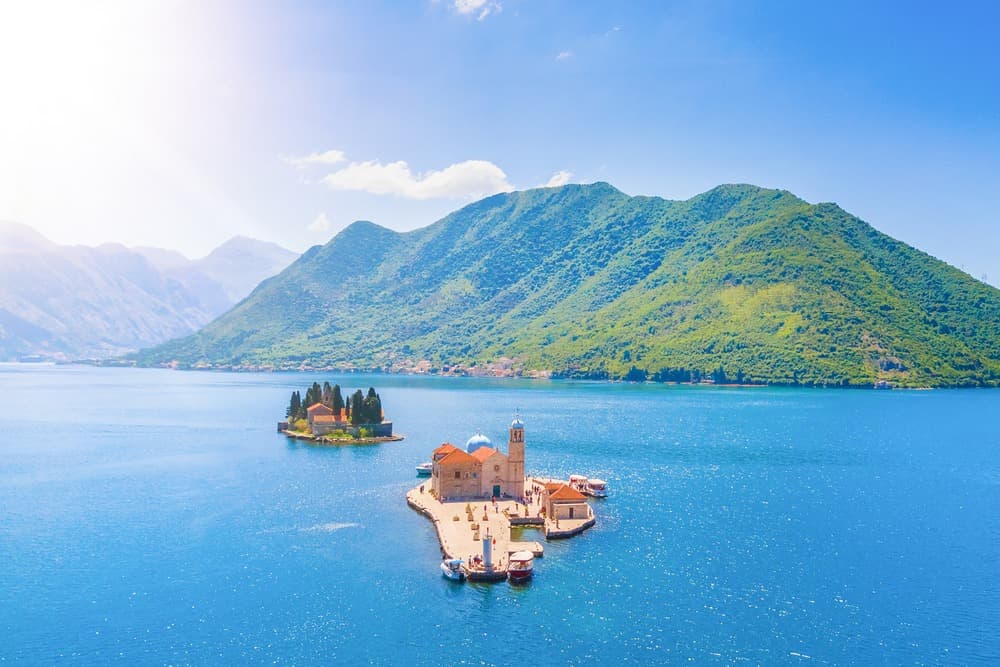
Off the coast of Perast, in Kotor Bay, the island of Our Lady of the Rocks (Gospa od Škrpjela) is one of the rare artificial islands in the Adriatic. Built from a reef in the 15th century, it houses a Catholic church with a blue dome and a small museum rich in paintings, votive offerings and objects linked to the maritime world of Perast's fishermen.
Why visit Our Lady of the Rocks
The site's appeal lies in three rarely combined elements: an island built entirely by human hands, a church adorned with baroque frescoes by Tripo Kokolja, and a living popular tradition, the Fasinada, which reenacts the founding gesture of the island each year. The crossing from Perast is short (just a few minutes by boat) and the visit, unpretentious, takes less than an hour.
History and founding legend
The artificial island of Our Lady of the Rocks was created in the 15th century. Legend has it that on the morning of July 22, 1452, two fisherman brothers found an icon of the Virgin and Child on an outcropping rock. When they brought it home, the image mysteriously disappeared and reappeared on the same rock several times over. The fishermen took this as the Virgin's wish to remain on this reef and set about building a chapel there.
To enlarge the rocky shoal, the inhabitants of Perast first sank boats laden with stones and then heaped rocks around the cliff. From this practice was born the Fasinada, celebrated each July 22: at sunset, a procession of decorated boats reaches the island and each person deposits a stone, symbolically continuing the work of the founders. The current church, remodeled several times, preserves this maritime memory.
What to see on site
The church and its paintings
The interior brings together the major work of Tripo Kokolja (1661-1713), a baroque painter from Perast, to whom we owe a vast cycle of canvases covering the ceiling and walls. The iconographic program blends Marian scenes with episodes of local life. At the center of the choir, a marble altar signed by Antonio Kapelano, a Genoese sculptor, dated 1796, frames the icon of the Lady of the Rocks attributed to Lovro Dobričević and painted in the mid-15th century.
Among the most remarkable pieces is a tapestry embroidered by Jacinta Kunić-Mijović, a woman from Perast. Tradition has it that she created it during her sailor husband's prolonged absence, weaving silver thread, gold thread and her own hair. The work allegedly took twenty-five years and left her blind.
The museum
Adjacent to the church, the small museum displays votive offerings left by sailors, silver plaques, weapons, costumes and archaeological objects from the Roman period recovered from the bay. Several objects have been enriched by donations from residents over the decades.
The neighboring island of St. George
Facing Our Lady of the Rocks lies the island of St. George (Sveti Đorđe), a natural one, nicknamed "the island of the dead". It is home to an ancient cemetery and a Benedictine abbey. A legend from the early 19th century tells of a French officer garrisoned there, in love with a woman from Perast killed in battle, who is said to have sworn to keep a candle burning there until his own death. The island is not open to the public due to underground electrical installations, but it can be perfectly viewed from Our Lady of the Rocks.
When to visit
The low season offers calmer conditions for your visit (more regular sea, little waiting for the boat), while from June to September crowds increase significantly. The year's highlight remains the Fasinada, July 22 at sunset: the procession of boats laden with stones, departing from Perast to reach the island, is the most emblematic event of Kotor Bay. The next day, traditional regattas are held on the strait.
Practical information
- Duration of visit: allow 45 minutes to 1 hour, including the crossing.
- Dress code: shoulders covered recommended to enter the church.
- Admission: modest entrance fee for the church-museum, additional fee for the boat crossing from Perast. Prices vary by season.
- Nearby: the restaurant Stari Mlini, housed in a former grain mill from 1670 restored by the Đurica family in 1976, offers seafood cuisine in Ljuta Bay, just minutes from Perast.
How to get there
The starting point is Perast. From Kotor, allow approximately 30 minutes by car or bus along the coastal road. In Perast, private boats depart continuously from the main quay and deposit visitors on the island; return is arranged at the time of purchase. Many boat excursions in Kotor Bay include a stop at Our Lady of the Rocks as part of a larger tour (Blue Cave, Mamula, Tivat submarine).
Nearby
- Perast: classified baroque village, Venetian palaces and St. Nicholas bell tower.
- Lovćen National Park: massif and Njegoš mausoleum, accessible in a day from the bay.
- Morača Monastery: medieval frescoes, on the road north.
Frequently asked questions
Frequently asked questions
Learn more
Our Lady of the Rocks naturally fits into an itinerary around Kotor Bay, between baroque villages, monasteries and national parks. To plan the rest of your stay, check out our Monténégro travel ideas.
Interested in this visit?
We can include it in your personalised itinerary.