Rozafa Castle
Rozafa Castle
A fortress perched above Shkodra, Rozafa Castle encompasses 4,000 years of history, a founding legend, and sweeping views over the lake and Albanian Alps.
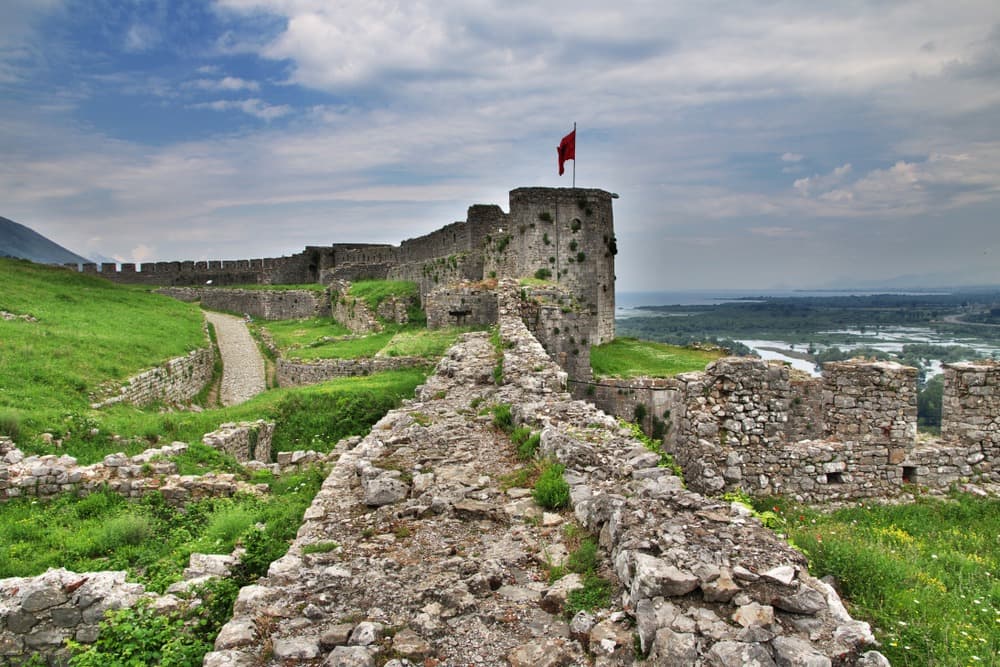
Rozafa Castle rises above the city of Shkodra, in northern Albania, just minutes from the Montenegrin border. Perched on Tepe Hill at 133 meters elevation, the fortress spans nearly 2 square kilometers and encompasses four millennia of history: Illyrian foundations, Venetian walls, Ottoman transformations. The site combines archaeological remains, panoramic views over Lake Shkodra, and a founding legend deeply woven into Albanian culture.
Why visit Rozafa Castle
Rozafa appeals equally to archaeology enthusiasts and travelers passing between Monténégro and Tirana. Several reasons justify the detour:
- A visible layering of successive civilizations: Illyrian, Venetian, Ottoman.
- A founding legend carved into stone, still vividly present in local imagination.
- A museum housed in a Venetian building, tracing 4,000 years of fortress history.
- An expansive viewpoint over Lake Shkodra, the Buna, Drin, and Kir rivers, and surrounding mountains.
History
Tepe Hill has been occupied since the Bronze Age. The Illyrians built an early stronghold here, with sections of walls still visible today in the foundations. Successive powers in the region subsequently took and expanded the site.
Most of the current walls date to the Venetian period, late 14th century. Shkodra was then Venice's forward outpost against Ottoman expansion. In 1479, after a long siege, the fortress fell to the Ottoman army led by Mehmet II the Conqueror. It remained a military garrison for several centuries before being gradually abandoned in the 19th century.
The legend of Rozafa
The castle's name comes from a legend passed down orally for centuries. Three brothers attempted to build the citadel's walls, but what was constructed by day collapsed each night. A sage told them a sacrifice was needed: the first of the three wives to bring the midday meal would be sealed alive into the foundations. It was Rozafa, the youngest. Before being sealed in, she begged that half her body be left exposed so she could continue to nurse and soothe her newborn child. A sculpture depicting this scene stands near the main entrance.
What to see on site
The enclosure comprises three main courtyards, arranged in succession along the ridge. The main entrance, built in the 15th century, marks the start of your tour.
First courtyard
Here stands the site's oldest structure: a section of Illyrian wall, testament to the earliest fortifications. The courtyard also contains medieval cisterns, the Balshaj Towers (named after the Balshaj dynasty, which controlled the region in the 14th century) and remains of former Venetian dwellings.
Second courtyard
It preserves the vestiges of Saint Stephen's Church, a Romanesque structure characteristic of Albanian sanctuaries built between the 13th and 15th centuries. After the city's capture, Mehmet Fatih had it converted into a mosque. The building was finally abandoned in 1865. Walls and the entrance arch survive partially.
Third courtyard and museum
The highest courtyard holds the "Capitole," a three-story Venetian building that once housed military authorities. Today it hosts the Shkodra Castle Museum. The multilingual exhibition traces 4,000 years of site history and showcases the city's great medieval families, Illyrian daily-life objects, Ottoman military equipment, and ancient coins.
From the ramparts, your view extends over Lake Shkodra, the rivers, and the peaks of the Albanian Alps.
When to visit
The castle welcomes visitors year-round, but late spring (May–June) and early autumn (September–October) offer the best conditions: moderate temperatures, favorable light for panoramic views, manageable crowds. In peak summer, the heat can be intense on the sparsely shaded hill. In winter, daylight hours are short and opening hours limited; verify current times on-site before heading up.
Practical information
- Location: Tepe Hill, approximately 3 km southwest of Shkodra's city center.
- Visit duration: allow 1.5 to 2.5 hours to explore the three courtyards and museum.
- Admission: modest entry fee, payable in lekë on-site.
- Accessibility: the final ascent is made on foot via a paved path, sometimes uneven. Closed-toe shoes recommended.
- On-site: a café is typically open in season near the entrance. No substantial dining options; bring water.
How to get there
Shkodra is 116 km from Tirana, roughly 2 hours by bus from the capital's northern bus station. Furgons (shared minibuses) also connect the city to Thethi, Kelmend, Koman, and Velipojë.
From Monténégro, daily buses depart from Podgorica and Ulcinj. From Kosovo, a connection runs from Gjakova via the Prizren highway.
To reach the castle from Shkodra's center, taxi remains the simplest option (short ride). A municipal bus also serves the stop at the foot of the hill; a ten-minute uphill walk follows.
What to see nearby
Shkodra is one of the Balkans' oldest cities. Its historic heart with pastel-colored facades invites leisurely wandering. Must-see attractions:
- The Serreqi and Gjuhadoli neighborhoods, among the city's most ancient quarters.
- The Marubi National Photography Museum, chronicling 150 years of Albanian photography.
- The Shkodra Historical Museum, housed in a traditional mansion.
- The Memory Museum, dedicated to the communist period.
- Lake Shkodra and its fishing villages, accessible by bicycle from the city.
On the neighboring Montenegrin side, the Lovćen National Park and the Morača Monastery naturally extend an itinerary between the two countries.
Frequently asked questions
Frequently asked questions
The castle stands on Tepe Hill, approximately 3 km southwest of Shkodra's city center, in northern Albania, near the border with Monténégro.
Allow 1.5 to 2.5 hours depending on your interest in the museum. The three courtyards and ramparts require about an hour of walking; the Capitole museum takes 30 to 45 additional minutes.
The castle takes its name from Rozafa, a young wife sealed alive according to the founding legend. She reportedly asked that half her body be left exposed to continue nursing her child. A sculpture depicts this scene near the entrance.
Yes, though with seasonal hours: extended opening from late spring through early autumn, more limited in winter. May–June or September–October are ideal times to visit.
Absolutely. Shkodra is connected by bus to Podgorica and Ulcinj. The castle integrates easily into a cross-border itinerary through the Western Balkans.
Planning the rest of your journey
To extend your regional exploration, consult our itinerary suggestions on Monténégro, Shkodra's direct neighbor and natural gateway to the Dinaric Alps.
Interested in this visit?
We can include it in your personalised itinerary.