Bay of Kotor
A 28-kilometre bay framed by limestone slopes that rise to 1700 metres, where Venetian Kotor, Perast with its twelve shipowner palaces, and two accessible islets line the shore.
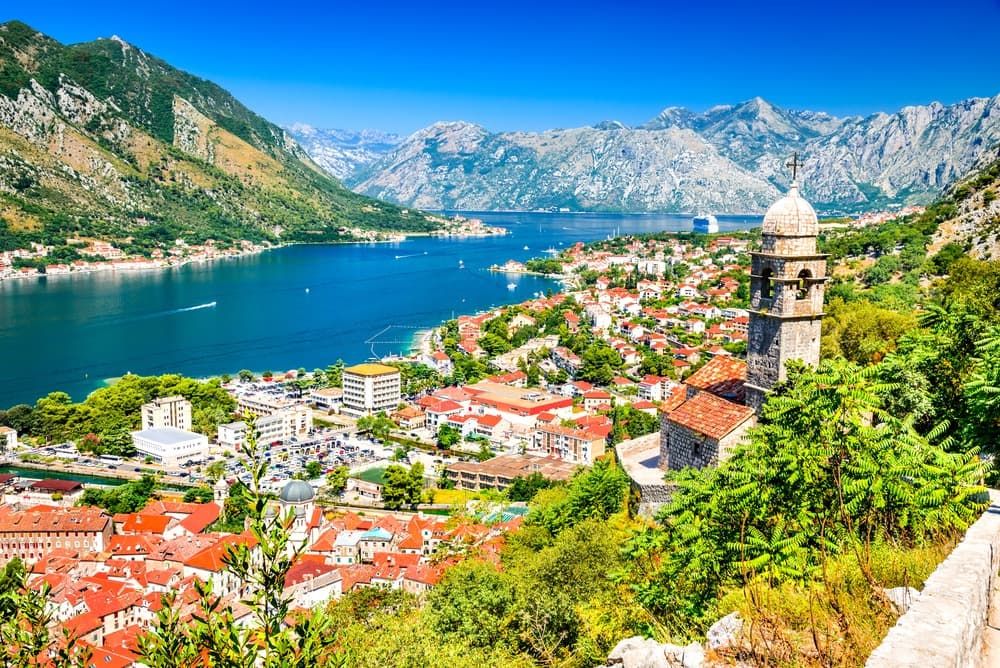
The Bay of Kotor, known locally as Boka Kotorska, forms a system of four nested bays that penetrate 28 kilometres inland from the Adriatic. The geography is singular: the limestone slopes of the Orjen massif to the north and Lovćen to the south plunge directly into the sea, reaching 1894 metres at Zubački kabao. This configuration, sometimes described as the only fjord in southern Europe, is in fact a submerged river canyon following the last glaciation. The result is coastal villages squeezed between rock and water, without a coastal plain, and a humid microclimate that contrasts with the rest of the Montenegrin coast.
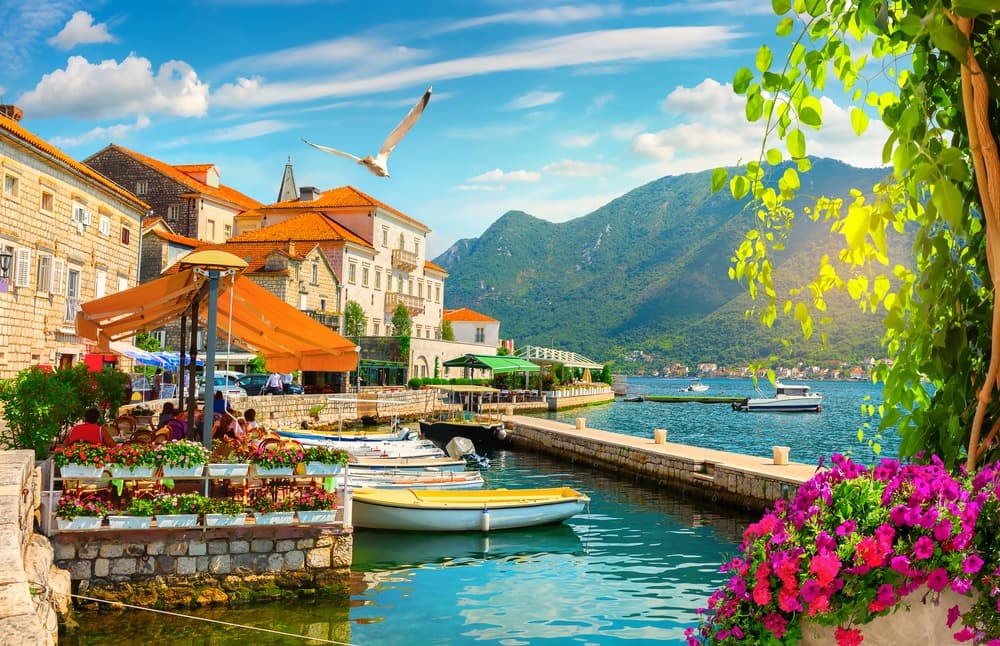
The culture of the Bay bears the mark of four centuries of Venetian rule, between 1420 and 1797. This is evident in the architecture of Kotor, Perast, Prčanj and Dobrota: winged lions sculpted on doorways, baroque palaces of merchant captains, bell towers, rainwater cisterns. The Boka navy, organised as a confraternity since the 12th century, supplied pilots and captains to Venice. In Perast, the twelve palaces of shipowner families, including the Zmajević and Bujović, line their facades along 400 metres of quay. The region remains largely Catholic, while the interior of the country is predominantly Orthodox: the two faiths coexist here, sometimes on the same street.
Kotor concentrates urban life. The old town, within the walls, can be explored on foot in a morning: Arsenal Square, St. Tryphon's Cathedral consecrated in 1166, St. Nicholas Orthodox Church, fish market along the south rampart. The climb to San Giovanni fortress takes 1350 steps hewn into limestone and climbs 280 metres above the bay. We recommend doing it before 9 a.m. in summer, when the rock has not yet absorbed the heat. Outside the walls, the village of Muo and the Dobrota promenade offer a more serene experience of the bay, with stone houses converted into small family hotels.
Perast, 12 kilometres from Kotor, is the other anchor point. The village has only one street and around 270 permanent residents. Facing the quay, two islets: St. George, natural and planted with cypress trees, which houses a Benedictine abbey closed to the public, and Our Lady of the Rocks, artificial, built from the 15th century by sailors from Perast who threw a stone into the sea with each safe return from voyage. The boat crossing from Perast takes 5 minutes. The church houses a collection of 68 silver ex-votos and a canvas by Tripo Kokolja painted in the 17th century. Each 22 July, the Fašinada festival sees residents throw stones around the islet to reinforce its base, an unbroken tradition since 1452.
Local gastronomy is built around bay fishing and the mountainous interior. The konobas of Stoliv and Prčanj serve rižot crni with cuttlefish, Boka mussels raised in the shallow waters near Risan, and pršuta from Njeguši, ham smoked with beechwood in the high-altitude village of the same name, at 880 metres, on the road to Lovćen. Local wine, primarily Vranac and Krstač, comes from the hillsides of Crmnica south of Lake Skadar. As for climate, the Mediterranean character dominates on the shores, with 26 to 30 °C in summer and sea at 24 °C in August, but the Bay also receives nearly 4500 mm of rain annually in its northern part, one of the highest totals in Europe, which explains the very dense vegetation on the slopes.
Risan, at the far end of the inner bay, deserves a stop for its Roman mosaics from the 2nd century, including a rare depiction of Hypnos. Further east, the road climbs towards the Vrmac pass and descends to Tivat, whose Porto Montenegro marina transformed the former Yugoslav naval base into a yacht harbour since 2009. Today this is the sharpest contrast in the Bay: Perast and its village rhythm, Tivat and its superyachts, 20 minutes' drive apart.
To discover
Climb to San Giovanni fortress. 1350 steps from Kotor's old town, 280 metres elevation gain, commanding views of the inner bay. We depart before 9 a.m. to avoid the heat on the limestone rock.
Boat crossing to Our Lady of the Rocks. A 5-minute boat ride from Perast's quay to the artificial islet built stone by stone since 1452, whose church preserves 68 silver ex-votos offered by Boka sailors.
Njeguški road and Lovćen pass. 25 hairpin bends from Kotor to the village of Njeguši at 880 metres, where pršuta has dried in smokehouses for five generations. Extension possible towards the mausoleum of Petar II Petrović-Njegoš.
Roman mosaics of Risan. Remains of a 2nd century villa at the far end of the bay, with a pavement depicting Hypnos reclining, one of the rare known depictions of the god of sleep.
Fašinada in Perast on 22 July. Nocturnal procession of boats laden with stones around Our Lady of the Rocks islet, male polyphonic singing, an unbroken tradition since the 15th century.
When to visit
The most comfortable window extends from mid-May to mid-June and mid-September to mid-October. Temperatures range between 22 and 27 °C, the sea remains swimmable until October around 22 °C, and the light on the slopes is softer than in mid-summer. July and August reach 30 to 33 °C during the day, with significant humidity due to the enclosed terrain, and above all the daily arrival of several cruise ships in Kotor, sometimes reaching 8000 combined passengers on certain days. We then schedule visits to the old town between 7 a.m. and 10 a.m., or late afternoon after 5 p.m.
From November to March, the Bay receives most of its 4500 mm of annual precipitation, with episodes of continuous rain lasting several days and temperatures between 8 and 13 °C. Swimming is no longer feasible, but low season remains practical for visitors interested in heritage, konobas open in winter and the particular light on wet cliffs. April offers an intermediate situation, with around 20 °C, flowering on the slopes and still-modest visitor numbers.
Practical advice
We recommend a minimum of 3 full days in the Bay of Kotor: one day for old town Kotor and the fortress, one day for Perast and the islets with an extension to Risan, and a third devoted to the Njeguški road or the Luštica peninsula. With only 2 days, you must sacrifice either the interior or the outer bay. The logistical entry point is Tivat airport, 8 kilometres from Kotor, served in season from several European capitals. Podgorica, 90 kilometres away and 1.5 hours by road via the Sozina tunnel, remains a year-round alternative.
The Bay combines naturally with Cetinje and Lovćen, accessible in 1.5 hours via the scenic Njeguški road, and with the coast from Budva to Ulcinj to extend along the southern shoreline. A ten-day loop can link Bay of Kotor, Lovćen, Lake Skadar and descent to Ulcinj. For travellers also wanting the northern mountains and Durmitor, allow a minimum of 14 days. Comfort levels are high, with characterful guesthouses in renovated palaces in Perast and Dobrota and several 4 and 5-star hotels around Tivat. The region suits contemplative travellers, heritage and architecture enthusiasts, and families with children from 7-8 years old for the climb to San Giovanni. Hikers will find their way on trails of the Orjen massif or Vrmac, less crowded than those of Durmitor.