Durmitor National Park
Fifty peaks above 2,000 meters, eighteen glacial lakes and Europe's deepest canyon, five hours' drive from the Adriatic coast.
The Durmitor massif dominates the northwestern corner of the country, wedged between the gorges of the Tara and Piva rivers. Its heart, inscribed as a UNESCO World Heritage site in 1980, spans 390 km² of karst plateaus, pine forests and glacial cirques. Bobotov Kuk rises to 2,523 meters, with around fifty peaks exceeding 2,000 meters. This average elevation shapes everything here: the vegetation, the sheep herding that still anchors village life, and a climate utterly divorced from the Adriatic coast just under 150 kilometers away.
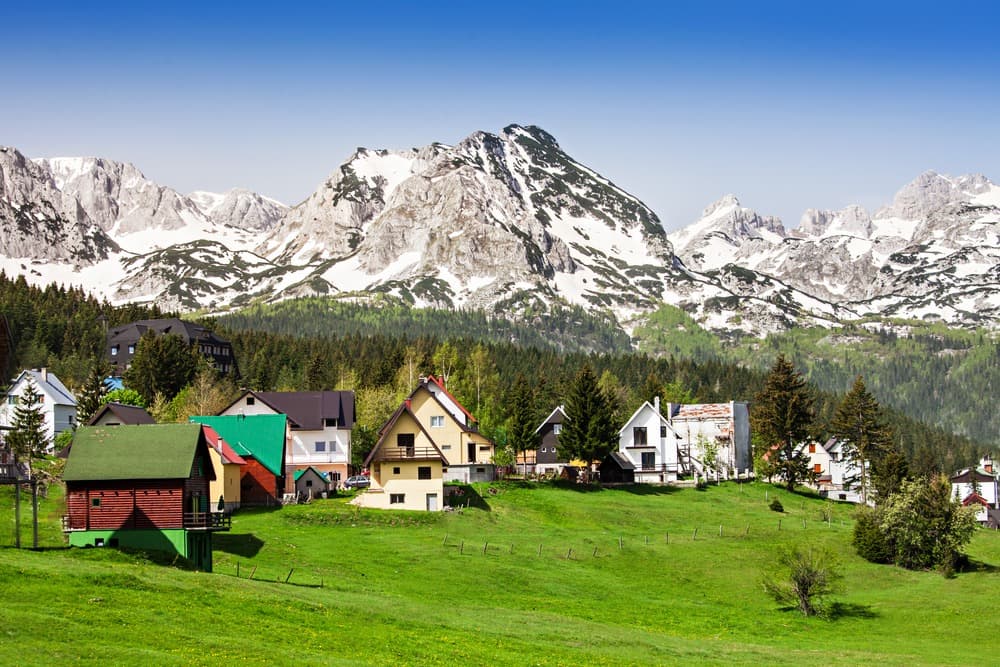
Žabljak, at 1,450 meters, is the Balkans' highest municipality and the logical base for exploring the park. The town holds just over 2,000 year-round residents, swelling in season. You'll find a cluster of family-run guesthouses, a handful of restaurants serving local mountain cuisine—kačamak made with potato flour and melted cheese, lamb cooked under the sač, smoked cheese from Njeguški—and trail heads leading to the main glacial lakes. Crno Jezero, the Black Lake, lies three kilometers from town and is the starting point for roughly 80% of the park's hikes. The other eighteen lakes demand longer walks: Škrčko Jezero in its eponymous cirque, Zminje Jezero deep in the black pine forest, Modro Jezero perched above 1,600 meters.
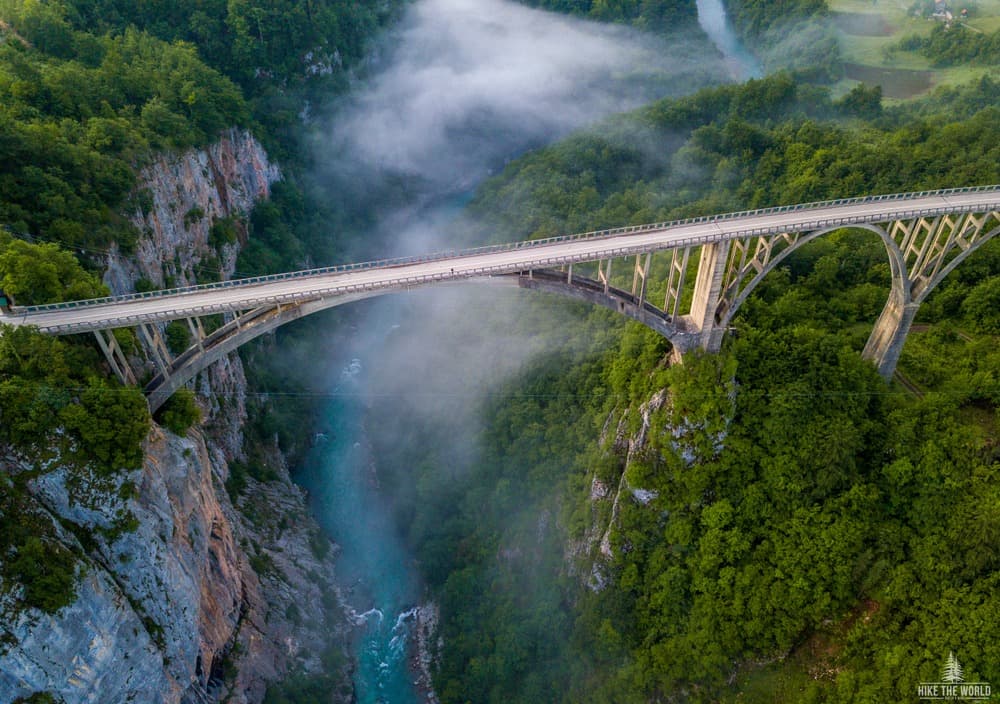
The Tara canyon borders the park to the east over 82 kilometers, plunging to depths of 1,300 meters—making it Europe's deepest and the world's second only to the Grand Canyon. The river itself, designated a biosphere reserve, is runnable by raft from May through October in sections ranging from class II to IV depending on water levels. The Đurđevića Tara bridge, an elegant 365-meter arc built in 1940, spans the gorge 172 meters above the water and ranks among the most accessible viewpoints, just twenty minutes' drive from Žabljak. On the western flank, the Piva canyon and its reservoir lake offer a starker landscape favored by local anglers.
Local culture remains rooted in pastoral tradition and the katuns—summer hamlets where shepherds once drove their flocks from June through September. Some of these katuns, notably Lokvice and Škrka, still function and welcome hikers for overnight stays or meals. It's a chance to taste fresh kajmak, a fermented cream; air-dried pršut from the heights; and local plum rakija. The region also carries vivid memory of partisan resistance in World War II: the Battle of Sutjeska unfolded partly across these ridges in 1943, and several monuments mark the trails.
Geologically, Durmitor reads like an open book on the Quaternary glaciations. The cirques, moraines and strung-out lakes all bear witness to glacial retreat, while the karst sinkholes peppering the Jezerska Površ plateau number in the thousands. Wildlife includes brown bears, wolves, chamois and golden eagles, observable with patience and a local guide. Flora counts over 1,300 species, among them the endemic Bosnian pine (Pinus heldreichii), with some specimens in the Crna Poda forest exceeding 400 years old.
For our team based in the capital, Durmitor represents the mountainous dimension many travelers underestimate upon arriving on the coast. It rounds out a full exploration of the country with a complete change of scale: 5 to 10 °C cooler than Kotor in July, distances measured in hours on winding roads, and a way of life that remains rural.
Must-see highlights
Bobotov Kuk traverse from Lokvice. Six to eight hours round trip with 1,200 meters of elevation gain, following the marked trail that traces the Velika Kalica cirques. Views sweep across the entire massif and, on clear days, reach toward the Albanian Alps.
Tara rafting between Brštanovica and Šćepan Polje. Eighteen kilometers descending through class III sections with passages through the most dramatic gorges. Day trips or two-day camping runs, May through October based on flows.
Overnight in the katun at Škrka. Four to five hours' hiking from Sedlo to reach a summer hamlet at 1,700 meters, dinner shared with a shepherd family, cheese and lamb cooked over a wood fire.
Crna Poda forest and Bosnian pines. Forest reserve on the Tara's edge sheltering endemic pines, some exceeding 400 years and 30 meters tall. Easy one-hour trail.
Đurđevića Tara bridge from below. Glimpsed from water level during a rafting descent, the 365-meter arc built in 1940 takes on another dimension entirely. Bungee jumping available in season.
When to visit
The ideal window for hiking falls between mid-June and mid-September. Temperatures in Žabljak range from 8 °C at night to 22–25 °C in the afternoon, versus 30–33 °C on the coast over the same period. High-altitude trails are snow-free from late June in normal years, sometimes later on northern exposures. July and August draw the largest crowds, especially around the Black Lake and the Tara bridge; for quieter hiking we suggest the first half of June or the second half of September, when autumn colors emerge.
From November through April, snow settles in for the long haul, averaging 1.2 meters on the ground in February with frequent lows around -10 °C. The Savin Kuk ski station operates then, but summiting on your own requires alpine mountaineering skills. May and October are transition months: high trails may still carry snow or be already closed, rains frequent (150–200 mm cumulated over the month), yet this is prime season for Tara rafting, when water levels remain robust.
Practical advice
We recommend a minimum of three nights on-site to justify the drive, though four to five nights let you combine hiking, rafting and a katun overnight. Žabljak is reached in four hours from Podgorica via Nikšić and Šavnik, or in five hours from Kotor. The coastal route crosses passes above 1,400 meters and winds considerably: we always arrange a driver familiar with the terrain. Podgorica airport remains the most practical entry, though Tivat works too but adds an hour to the journey.
The region pairs naturally with the North and Biogradska Gora (primary forests and a glacial lake, two hours east), and logically with Cetinje and Lovćen on the return toward the coast. A ten-day Durmitor plus Bay of Kotor combination works brilliantly, delivering the full sweep from high mountain to Mediterranean shore. Comfort in Žabljak hinges on family guesthouses and a few three-star hotels, nothing lavish: we guide travelers seeking high standards toward more comfortable bases with day excursions, though this means long driving days. Durmitor suits hikers particularly well, families with children old enough to walk (eight years and up for main trails), and contemplatives content with simple lodging in exchange for unspoiled rural surroundings.